
Augur Prediction Marketplace Clone Software Development
The world of prediction markets has evolved with decentralized platforms like Augur leading the way. Built on Ethereum, Augur allows users to buy and sell shares tied to real-world event outcomes without a central authority. It’s peer-to-peer trading that turns collective wisdom into actionable insights. No middlemen, no biases, just transparent, trustless markets.
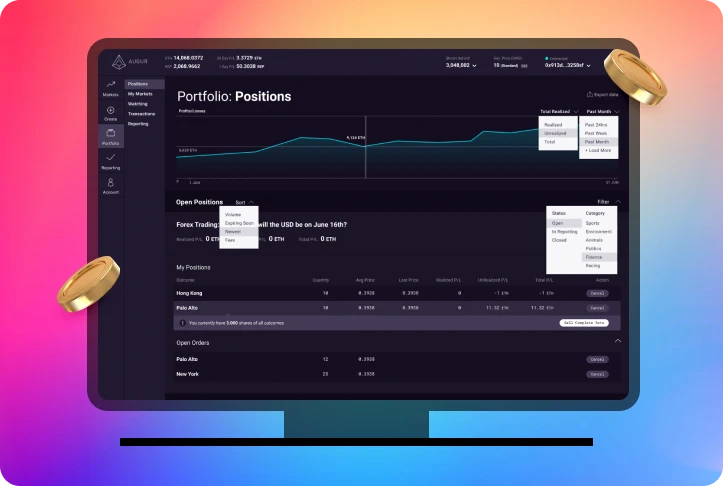
You know, decentralized prediction markets are growing fast. The global decentralized prediction market was valued at $1.4 billion in 2024 and is set to skyrocket to nearly $95.5 billion by 2035, showing a massive compound annual growth rate of about 47%. Augur sits right at the heart of this surge. With a user base drawn from all corners of the globe, and the promise of censorship resistance, Augur’s platform is expected to flourish alongside the booming blockchain ecosystem.

What is Augur?
Augur is a public prediction market built on the Ethereum network. It lets people create markets on almost anything from election results to football matches. The entire setup runs through smart contracts that handle trades, payouts, and reporting without middlemen.
Here’s the key difference: no one owns or runs Augur. It’s fully decentralized. Users trade, report, and settle outcomes through code instead of relying on a central authority. To keep everything honest, Augur uses a token called REP. Holders stake REP when reporting event results, which keeps reporting accurate and fair. If someone tries to cheat, they risk losing their tokens.
That’s how the system stays trustworthy, a community-driven structure backed by blockchain transparency.
 Launch Your Polymarket Clone Script in Just 2 Weeks — Build the Next-Gen Prediction Market Platform
How Does an Augur Clone Work?
An Augur clone works on the same principle but lets businesses or developers create their own version of the system. It uses smart contracts to record every trade and payout securely. Nothing can be altered once the data hits the chain, so users always know the market is fair.
The platform lets users trade shares based on possible outcomes. These outcomes can be simple yes-or-no results, multiple-choice, or number-based ranges. This flexibility helps cover everything from sports results to market trends.
Each market includes a reporting phase where users confirm the result of an event. If there’s disagreement, the dispute process activates, and the community steps in to verify the truth. This approach keeps settlements transparent while discouraging bad reporting.
In short, an Augur clone gives you the freedom to run a decentralized prediction market with your own branding and control but without giving up transparency or fairness.
Key Features of Augur Clone Prediction Software

Decentralized Outcome Resolution
Oracles and community voting verify real-world results to ensure fair settlements.

User-Friendly Interface
Simple navigation for easy market creation, trading, and result tracking—even for beginners.

Advanced Security Protocols
Encryption, multi-signature wallets, and fraud checks protect user data and funds.

Multi-Currency & Wallet Integration
Supports popular crypto wallets like MetaMask and multiple tokens for seamless global participation.


Automated Liquidity Management
Built-in market makers maintain balanced odds and active trading across all markets.

Decentralized Market Creation
Anyone can launch a prediction market on real-world events without intermediaries, ensuring global access and censorship resistance.

Smart Contract Automation
Markets, trades, and payouts run on tamper-proof smart contracts, ensuring full transparency and zero manual errors.

Real-Time Trading Engine
A fast, liquidity-backed system enables instant order matching and dynamic odds updates.
Why Augur Clone Prediction Software is Popular
Augur’s core appeal lies in true decentralization. Users trade directly without intermediaries, reducing fees and trusting the blockchain’s transparency. The platform’s reputation token ensures accurate reporting, which adds a layer of trust unique among marketplaces. These elements draw a global audience seeking unbiased, censorship-resistant markets.
Plus, Augur supports flexible betting options. Binary yes/no markets coexist with multiple-choice or scalar types, giving users variety. The decentralized dispute resolution process also builds confidence in fair outcomes.
The rising crypto adoption, combined with a hunger for transparent alternatives to traditional sportsbooks, means Augur clones are gaining traction. According to industry insights, decentralized prediction market adoption is forecasted to grow 47% annually through 2035 [source: metatechinsights.com]. Augur’s architecture places it well for this growth.
Benefits for Operators

Lower Development Costs
Pre-built clone scripts reduce time and money compared to building from scratch.

Global Market Reach
Decentralized nature attracts worldwide users without geographic barriers.

Multiple Monetization Streams
Revenue from fees on trades, market creation, staking, and premium subscriptions.

Transparency and Trust
Blockchain smart contracts show transaction immutability and fairness.

Flexible Market Design
Supports binary, categorical, and scalar prediction types for diverse events.

Strong User Engagement
Community-driven governance and dispute resolution encourage active participation.
 Kalshi Prediction Marketplace Clone Software – Build Your Regulated Event Trading Platform
Revenue Model of Augur Clone Software
Augur clone platforms offer solid revenue models that allow operators to generate steady income while growing the user base and enhancing market liquidity. By blending multiple monetization streams, the platform stays financially healthy and incentivizes active participation.
Primary Revenue Streams

Transaction Fees
Charges a small fee each time users buy or sell prediction shares. Volume of trades drives steady income.

Market Creation Fees
Imposes fees when users create new markets, ensuring only meaningful events are listed and generating revenue.

Settlement Fees
Nominal fees collected at the time of payout distribution, scaling with platform activity.

Premium Memberships
Offers users perks like lower fees, priority access, and exclusive markets via paid subscriptions.

Advertising & Sponsorships
Monetizes user traffic by selling ad space or sponsoring specific markets or events.

Liquidity Pool Fees
Rewards operators by charging fees from users who provide liquidity in decentralized market pools.

Data Monetization
Aggregated user insights and market data sold to interested third parties.
How Augur Clone Earns Money
Every trade users make generates a small transaction fee that adds up as your platform gains traction. Market creators pay to list new events, which helps keep the marketplace active and profitable. When betting markets close, a settlement fee on payouts ensures further income. Offering premium accounts for serious users provides a recurring revenue source. Ad placements and sponsorships tap into platform traffic, boosting earnings without impacting users. Operators can benefit from liquidity pools, incentivizing smooth market activity. Lastly, market data presents opportunities for additional monetization streams.
Market Creation Process in Augur Clone
Creating a market is simple and user-driven. A user defines the event, outcomes, trading rules, and deadline. Smart contracts lock these parameters in place, making them immutably enforceable. Participants stake funds predicting results by buying shares. Orders match in real time with dynamic pricing adjusting based on demand. Once the event concludes, oracles verify outcomes. Community reporters resolve disputes fairly when unclear. Smart contracts automatically distribute winnings to those who predicted correctly. This transparent flow fosters trust and active market participation.
Development Process, Latest Improvements, and Compliance Overview for Augur Clone Software
Creating a decentralized prediction platform takes proper planning and technical depth. Here’s how most projects move from concept to launch.
Requirement Analysis and Market Research
Start by defining your audience. Are they sports fans, traders, or political watchers? Choose event categories that fit their interests. Planning this part carefully helps avoid clutter later.
Blockchain Selection
Ethereum remains the top choice for this model due to its active community and mature infrastructure. Some developers pick Polygon or Binance Smart Chain when they want faster transactions and lower costs.
Smart Contract Development and Audit
Develop the system using Solidity. Before launching, get your contracts audited. A single bug can cause losses, so testing and review are non-negotiable.
User Interface Design
Keep the design simple. Users should find it easy to open a market, place trades, or check outcomes. Clear visuals reduce confusion and build trust.
Wallet and Multi-Currency Integration
Add support for Ethereum-based wallets like MetaMask. Accept major tokens to make deposits and withdrawals convenient for every user.
Liquidity and Trading Engine Setup
Integrate AMMs and liquidity pools. These features maintain active markets and prevent price freezes. The trading engine must handle quick order matching without lags.
Oracle Integration for Outcome Resolution
Use decentralized oracles or voting systems to pull event data. When disputes arise, the network validates final results transparently.
Compliance and KYC
Add tools for KYC verification and location-based access. Different regions have unique rules, so this layer helps your platform stay legal and safe.
Testing and Quality Assurance
Run detailed tests before going live. Every feature from trading to payouts should perform smoothly under load. Security checks protect users and your reputation.
Deployment and Launch
Once everything passes testing, deploy your contracts to the blockchain. Then launch the platform and start building your community of traders and creators.
 Crypto Prediction Market Clone Script – Build Decentralized Forecasting Platforms Faster
Latest Developments in Augur Ecosystem (2024–2025)
Augur, like many decentralized platforms, has been evolving rapidly amid growing regulatory and technical challenges. In recent years, the platform focused heavily on improving user experience and governance. It embraced Layer 2 scaling solutions to reduce Ethereum gas fees and boost transaction speed. This was critical to attract everyday users beyond the crypto hardcore.
On the regulatory side, Augur maintained its commitment to decentralization while gradually enhancing compliance features. It implemented optional KYC processes and geofencing modules to meet regional restrictions without sacrificing user sovereignty. These additions help Augur clones operate in regulated jurisdictions more smoothly.
Augur’s dispute resolution mechanism recently saw upgrades, making it faster and less costly to resolve unclear market outcomes. The community-driven reporting model using reputation tokens (REP) became more robust, discouraging dishonest or malicious reporting.
In 2025, the platform also advanced oracle integrations to improve data quality and transparency. Oracles now support multi-source verification, reducing risks of manipulation and increasing trust in market resolutions.
Compliance and Regulatory Considerations
Operating a decentralized prediction market calls for vigilance on compliance. While blockchain provides transparency, many jurisdictions require operators to implement KYC/AML checks to deter illicit activities. Geoblocking technology limits participation from restricted regions. TRUEiGTECH ensures your Augur clone includes these safeguards transparently integrated so your platform stays legal without interfering with decentralization principles.
Cost of Developing a Custom Angur Clone Solution
| Development Component | Estimated Cost Range (USD) | Description |
| Wireframing & UI/UX Design | $10,000 – $30,000 | Creating responsive designs and intuitive user interfaces suitable for decentralized markets. |
| Frontend Development | $20,000 – $50,000 | Building user-facing components for market creation, trading, and dispute resolution. |
| Backend & Smart Contracts | $40,000 – $90,000 | Developing core blockchain logic, market rules, payouts, and consensus mechanisms. |
| Blockchain Node & Infrastructure | $15,000 – $35,000 | Setting up Ethereum nodes, scalable servers, and APIs for reliable platform performance. |
| Oracle Integration | $10,000 – $25,000 | Connecting with secure oracles to verify real-world event outcomes automatically. |
| Wallet & Multi-Currency Support | $12,000 – $30,000 | Integration of crypto wallets and token handling to enable trading and deposits/withdrawals. |
| KYC/AML & Compliance | $20,000 – $45,000 | Tools to meet regulatory standards including identity verification and geographic restrictions. |
| Security Audits & Testing | $15,000 – $40,000 | Comprehensive smart contract audits, penetration testing, and user acceptance testing. |
| Maintenance & Support (Annual) | $15,000 – $50,000 | Ongoing software updates, security patches, and feature enhancements post-launch. |
Typical Total Cost Range: $157,000 to $395,000
Why Choose TRUEiGTECH for Augur Clone Development?

Blockchain Expertise
TRUEiGTECH’s team brings deep knowledge of Ethereum and blockchain technology to ensure your Augur clone is secure and efficient.

Tailored Solutions
We custom-build your platform to align with your vision, market, and regulatory needs without unnecessary features.

Robust Smart Contract Development
Our developers craft well-audited smart contracts that automate market creation, trading, and settlements correctly.

Seamless Wallet Integration
We integrate popular crypto wallets, allowing your users easy, secure access to your prediction markets.

Compliance-Focused Design
Built-in KYC, AML, and geo-blocking tools help you meet regulatory requirements without sacrificing decentralization.

Ongoing Support & Upgrades
We provide continuous improvement through updates, security patches, scaling assistance, and new feature rollouts.
It's a ready-made software replicating the main functions of Augur’s decentralized prediction market on Ethereum.
Yes, from binary to scalar and categorical markets with flexible event types.
Absolutely, it integrates MetaMask, WalletConnect, and other popular wallets.
Mainly Ethereum, with optional Layer 2 scaling solutions support.
Typically within a few weeks, depending on customization and integrations.
Yes, it’s designed to support thousands of simultaneous users with liquidity pool features.
KYC, AML verification, geo-blocking, and transaction monitoring are built in.
Smart contracts automate all payouts instantly after event outcomes are verified.
Yes, including updates, security audits, and feature enhancements.
They can customize fee structures to generate revenue.
They’re rare and resolved by community voting incentivized with REP tokens.
Yes, with full customization options for branding and UI.
Indeed, with integration for various cryptocurrencies.
Our clone uses open-source foundations but includes proprietary customizations for performance and security.
Check Our Prediction Market Clone Development
Prediction Market Platform Development | Kalshi Prediction Market Clone Software | Polymarket Prediction Market Clone Software | Better Fan Prediction Market Clone Software | Polymex Prediction Market Clone Software | Duel Duck Prediction Market Clone Software | Plotx Prediction Market Clone Software | Oriole Insight Prediction Market Clone Software | Hedgehog Prediction Market Clone Software | Prejection Finance Prediction Market Clone Software | Probo Prediction Market Clone Software | Zeitgeist Prediction Market Clone Software | Manifold Prediction Market Clone Software | Predictit Prediction Market Clone Software | iowa Prediction Market Clone Softwar | Metaculus Prediction Market Clone Software